The Rosary, Philosophy, and the Preferential Option for the Heart
Oct 30, 2026
Lauren Galván
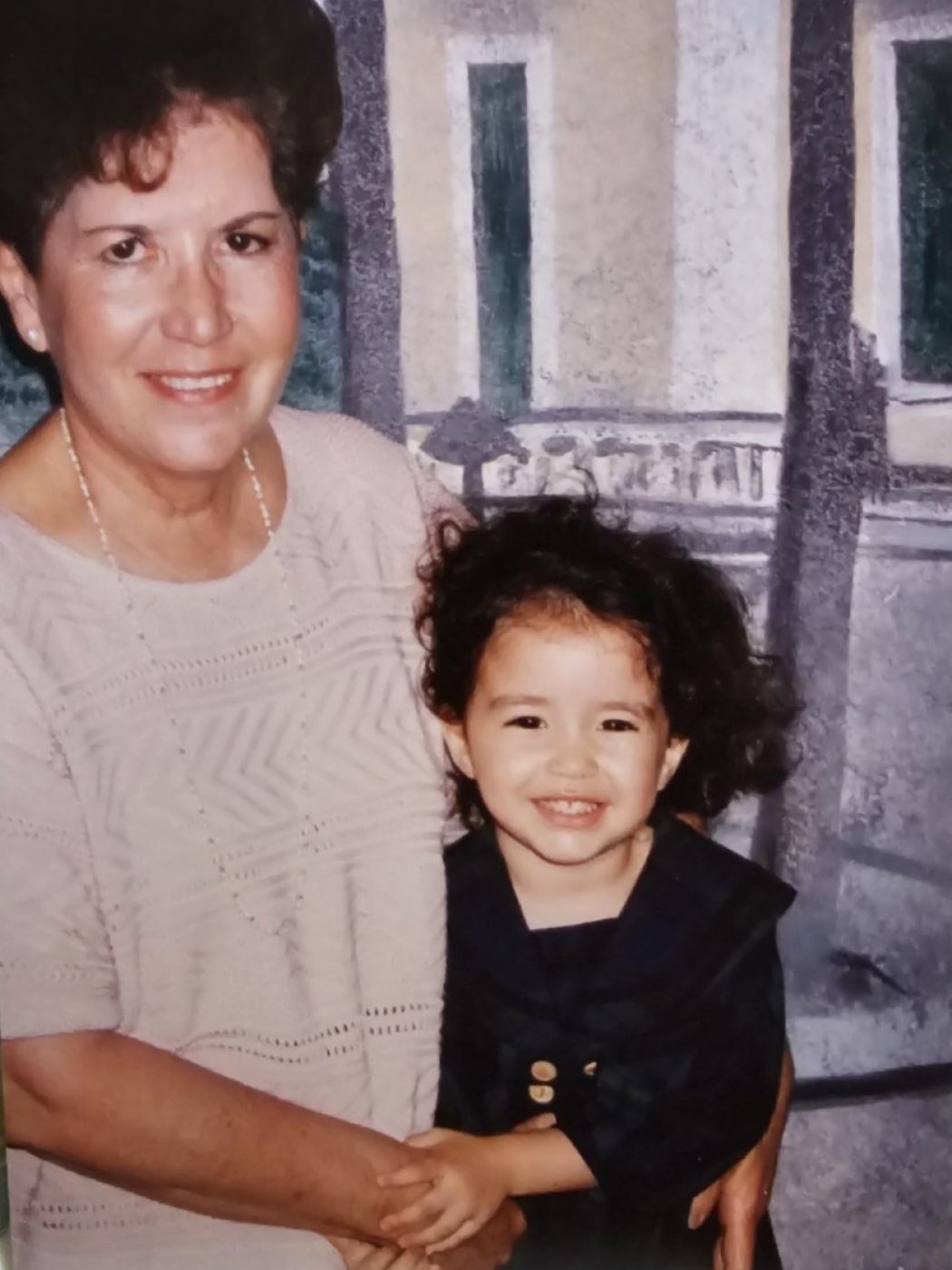
In memory of Englantina “Tina” Gonzales (December 15, 1936 — December 6, 2022)
A friend once told me that when God works in our lives, it’s as if He is shining a light on a diamond. Each way God moves us reflects light outward and strikes other people He puts in our path in different ways. Studying Metaphysics this fall under the guidance of Dr. Marco Stango has felt remarkably similar. My classmates and I have studied being from many different angles, holding that concept in our minds like a precious jewel, turning it around and around to learn all we can about it and to learn what great thinkers like Aristotle and St. Thomas Aquinas have contemplated about it as well.
When turning the jewel of being around in my mind, I cannot help but think of the people I’ve known throughout my life whose lives were so full that I find myself contemplating them like diamonds, too. I think especially about my grandmother, who died four years ago on the Feast of Saint Nicholas in 2022. “Mamo,” as we affectionately call her, was a wife, mother, grandmother, daughter, sister, and friend. Everyone she encountered experienced her light in unique ways based on the particular relationship she had with them.
One of the rays of light I appreciated most about Mamo was her devotion to the Holy Rosary. Fitting for a woman who was born on December 15—the Octave Day of the Feast of the Blessed Virgin Mary’s Immaculate Conception—Mamo loved the Blessed Virgin very much, and the Holy Rosary was her favorite prayer. In fact, Mamo prayed the Rosary daily, sometimes three times a day. She prayed so much that my grandfather would joke and say: “She prays more than the Pope!”
Throughout her life, my grandmother lived with steadfast faith, devoted herself to prayer, and cherished a great love for Jesus and Mary. In return for her great love for His Mother, God granted Mamo a very holy death. During her last hours on earth, Mamo was surrounded by her husband and four of her children. Her breathing was labored and she was making noises with each breath. At around 3 AM, my mother began praying the Rosary at Mamo’s bedside. When she finished, she made the Sign of the Cross over Mamo’s heart. At that moment, Mamo’s breathing cleared. The noises stopped. And she died peacefully thereafter.
From birth and in death, Mamo’s life was marked by a great love for all things heavenly. But this love didn’t come from books. Though she was an educated woman who devoted her career to teaching, Mamo never studied philosophy or theology. The primary way she knew God, especially toward the end of her life, was through her little tattered prayer book and her simple devotion to the Holy Rosary. Her knowledge of God came less from her intellect and more so from her heart. Mamo was so rooted and grounded in love [1] that, as Saint Gregory the Great would say, her love itself was knowledge. [2]
Because it came straight from her union with the Lord in prayer, Mamo’s knowledge of God was kept safe from the temptation to intellectual pride and idolatry [3] as Dr. Matthew Kuhner discussed during St. Bernard’s 2025 Academic Convocation. Throughout my own years of study, I have often reflected on the danger that Dr. Kuhner warned of that day—namely, that of allowing intellectual development to outpace the formation of one’s heart. In more recent years, based on my own struggles with intellectualism and from what I have observed in others, I have come to understand just how true that old saying really is—indeed, the habit does not make the monk. And, because of people like my grandmother, I would go on further to argue that it is not the intellect, either, that makes the saint.
People like Mamo make me believe in what I would call the preferential option for the heart—prioritizing love over reason alone in the pursuit of knowledge. Some people are not able to quote Aristotle or Aquinas. But, like Mamo, they may notice when you are sad and decide to say something to cheer you up. They may laugh at your jokes even if they aren’t very funny. They may say a quiet prayer for you if they see you struggling. Or, like she used to do, they may walk to the edge of the sidewalk when you drive away, waving and blowing kisses to make sure you don’t have the slightest shadow of a doubt that you, in particular, are beloved by them and that you hold a special place in their heart.
Sometimes—most of the time, I think—it’s these little acts of love that have the most profound impact on our lives, because, paradoxically, it’s these little acts that tell us just how much we are loved by another. Mamo knew the faith well enough to believe. But she didn’t just know the faith. She lived the faith, and lived it to the full [4]. She entrusted herself to the Lord, let her heart be transformed by His love, and, in return, loved her neighbor as herself. [5]
As my time at St. Bernard’s draws to a close (God willing, I will complete my degree by the end of next year), I can say with great confidence that studying philosophy at this school has been one of the greatest blessings of my life, especially because studying philosophy at St. Bernard’s does not end with the intellect alone. In fact, I would venture to say that the entire institution—especially its esteemed faculty—would agree that if philosophy ended with the intellect alone…let it be anathema!
As with all things that are true, good, and beautiful, the study of philosophy must end with the heart. That isn’t to say that we should neglect the intellect. Quite the contrary. Studying at St. Bernard’s has helped me know God more, contemplating Him, Ipsum Esse (Being Itself), from many different angles just like I would a diamond. But what I am most grateful for about being a student at St. Bernard’s is that I get to study philosophy at a place where the value of developing one’s intellect is put and kept in right order. Not above the heart. But through the heart. With the heart. And in the heart.
What I will treasure most about my time at St. Bernard’s isn’t necessarily all that I have learned. What I will treasure most will be that which I have learned has deepened my love for God and neighbor, and for the rest that comes from knowing, as Dr. Kuhner said, “that contemplation of and communion with the Lord is where my work begins and where my work resolves, being formed for service and ministry in the church of God.” [6]
To everyone I have encountered at St. Bernard’s, to the incredible faculty, and especially to the generous benefactors who have provided me with a scholarship to study, thank you for this beautiful opportunity to belong to “a place where I can live that unbroken circle of worship, study, and fellowship in pursuit of the one who is always beyond my grasp.” [7]
May we all, like my grandmother, never forget that the purest knowledge comes not only from knowing with the intellect, but also from the “giving over of the self to the revelation of God’s wisdom in Jesus Christ.” [8] Whether that’s done through praying the Holy Rosary, through serving one’s neighbor with little acts of love, or through studying philosophy and pursuing a degree or certificate program at St. Bernard’s, let all that we do be done in love [9]. For, as Saint John of the Cross says: “In the evening of life, we will be judged on love alone.” [10]
___________
[1] Ephesians 3:17
[2] Saint Gregory the Great, Homiliae in Evangelia, II.27.4, quoted by Dr. Matthew Kuhner, “The Love That Surpasses Knowledge: Love of God as the Source and Shape of Theology,” (St. Bernard’s School of Theology & Ministry, 2025). Youtube.
[3] Dr. Matthew Kuhner, “The Love That Surpasses Knowledge: Love of God as the Source and Shape of Theology,” (St. Bernard’s School of Theology & Ministry, 2025). Youtube.
[4] John 10:10
[5] Mark 12:31
[6] Kuhner, “The Love That Surpasses Knowledge.”
[7] Kuhner, “The Love That Surpasses Knowledge.”
[8] Kuhner, “The Love That Surpasses Knowledge.”
[9] 1 Corinthians 16:14
[10] Saint John of the Cross, "The Sayings of Light and Love," no. 60, in The Collected Works of St. John of the Cross, trans. Kieran Kavanaugh, OCD, and Otilio Rodriguez, OCD, 3rd. ed. (Washington, DC: Institute of Carmelite Studies Publications, 1991), 90.