Catholic Identity- St. Bernard's

Catholic Identity

St. Bernard’s is chartered by the New York State Education Department (NYSED) and accredited by The Association of Theological Schools (ATS) in the United States and Canada. St. Bernard’s is approved for participation in the State Authorization Reciprocity Agreement (SARA) by the National Council for State Authorization Reciprocity Agreement (NC-SARA), a national initiative that allows educational institutions to teach students throughout the United States while maintaining compliance with all state regulations.

Both institutionally and educationally, St. Bernard’s adheres faithfully to Ex Corde Ecclesiae, an Apostolic Exhortation promulgated by Pope St. John Paul II in 1990 addressing the nature and purpose of Catholic educational institutions, specifically universities. The heart of this document is the declaration that Catholic educational institutions are not extraneously related to the Church, but rather have “a relationship to the Church that is essential to (their) institutional identity” (Ex Corde Ecclesiae, §27). Fundamental to the document as a whole are paragraphs 12 through 14, which state that every Catholic educational institution, insofar as it is Catholic, must have the following essential characteristics:

  1. A Christian inspiration that is at the heart of the educational community and the individuals that make it up;
  2. A continuous reflection upon the growing treasury of human knowledge in light of the Christian faith, to which the Faith seeks to contribute by its own research;
  3. A deep fidelity to Christian teachings as they come to us through the Church;
  4. “An institutional commitment to the service of the people of God and of the human family in their pilgrimage to the transcendent goal which gives meaning to life” (§13).

The then Congregation for Education (now the Dicastery for Culture and Education) under Pope Francis reiterated these matters in its 2022 Instruction, “The Identity of the Catholic School for a Culture of Dialogue”: “a Catholic school is endowed with a specific identity: i.e. ‘its reference to a Christian concept of life centered on Jesus Christ.’ The personal relationship with Christ enables the believer to look at the whole of reality in a radically new way, granting the Church an ever-renewed identity, with a view to fostering in the school communities adequate responses to the fundamental questions for every woman and man” (§20).

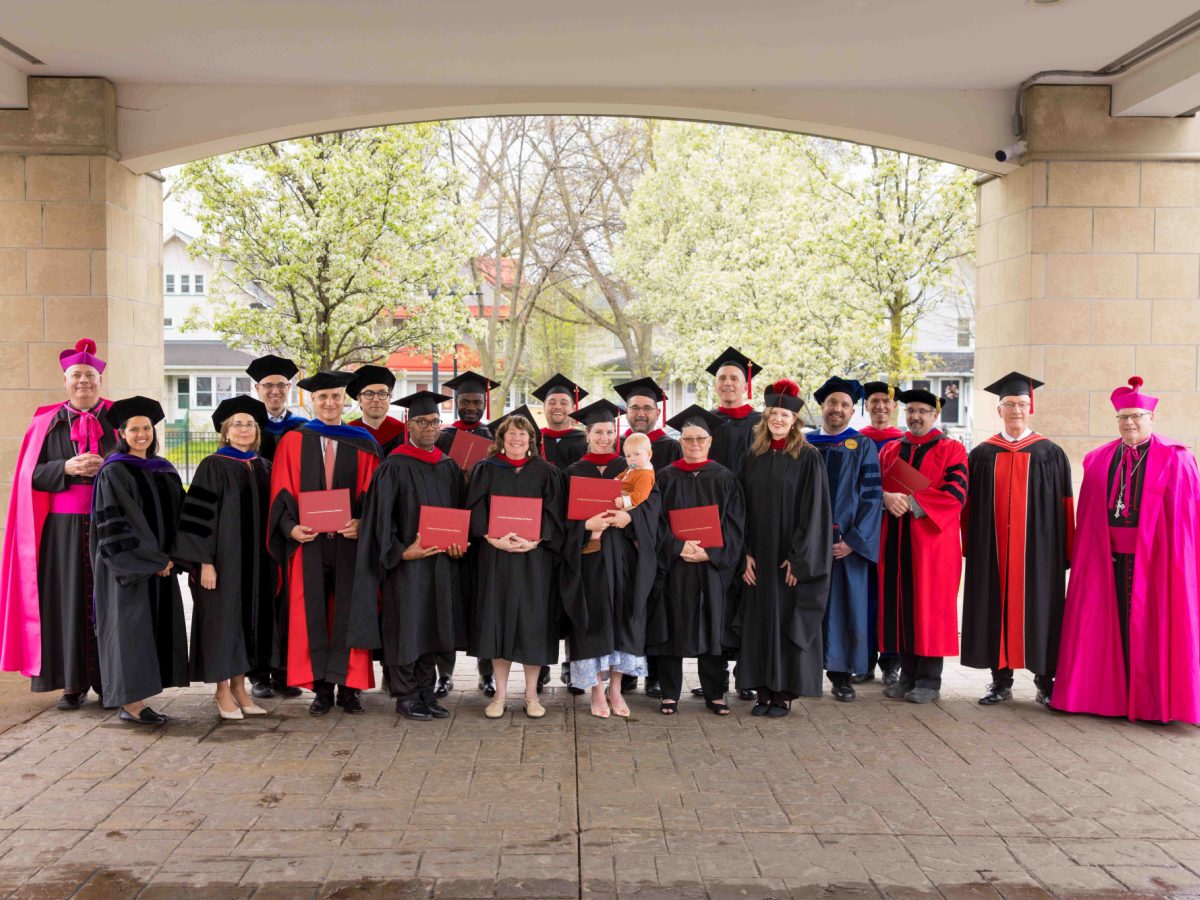
It is not enough, then, to base the Catholic identity of an educational institution upon the efforts of individuals in classrooms, offices, or ministries. In addition to these, there must also be an effort and commitment at the institutional level to allow Catholic “ideals, principles, and attitudes” to permeate the entire operation of an educational institution that calls itself “Catholic.” The institutional commitment of an educational institution to its Catholic identity always includes a close and essential relationship with its diocesan bishop. St. Bernard’s has enjoyed this throughout its history, currently with the Bishop of Rochester as its Chancellor, and lately with the Bishops of Albany and Syracuse, New York, and Allentown, Pennsylvania. Their leadership, guidance, and collaboration are invaluable to St. Bernard’s and serve as living examples of the intention of Ex Corde Ecclesiae (see §28).

Lastly, Ex Corde Ecclesiae is clear about the role of a Catholic educational institution within the Church’s mission of evangelization. Pope St. John Paul II notes that, “by its very nature, each Catholic University makes an important contribution to the Church’s work of evangelization. It is a living institutional witness to Christ and his message, so vitally important in cultures marked by secularism, or where Christ and his message are still virtually unknown” (Ex Corde Ecclesiae, §48). In collaboration, then, with the Bishops of Rochester, Albany, Syracuse, and Allentown, St. Bernard’s commits itself to being a “living institutional witness to Christ and his message” for all those who walk through its doors.